Bid to oust Taiwan’s China-friendly lawmakers rejected in closely watched poll
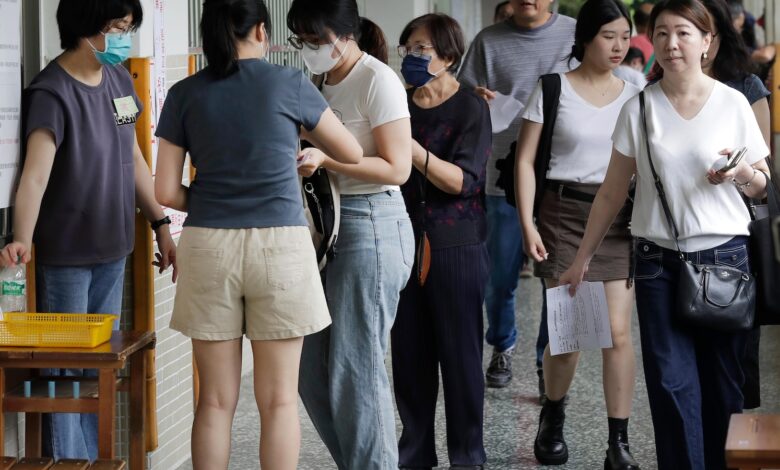
TAIPEI, Taiwan — Taiwanese voters have decided against removing approximately one-fifth of their lawmakers, all from the opposition Nationalist Party, in a recall election held on Saturday. This outcome has dashed hopes for the ruling party to shift the balance of power in the self-governing island’s legislature.
The ruling Democratic Progressive Party, which leans towards independence, won the presidential election last year. However, the China-friendly Nationalists, also known as the KMT, along with the smaller Taiwan People’s Party, possess enough seats to create a majority bloc.
Preliminary official results indicate that the attempts to recall the two dozen KMT lawmakers were unsuccessful. This recall election is unprecedented in scale, with an additional seven KMT lawmakers facing a similar vote on August 23.
Currently, the KMT holds 52 seats, while the ruling DPP holds 51 seats. In order for the DPP to secure a legislative majority, at least six KMT lawmakers would need to be ousted, and the ruling party would need to win the subsequent by-elections within three months of the results being announced.
In order for a recall to succeed, over a quarter of eligible voters in the electoral district must vote in favor of it, with the total number of supporters surpassing those voting against.
The voting concluded at 4 p.m. local time. The official results will be announced by Taiwan’s Central Election Commission on August 1.
Should the results of next month’s poll also not align with the DPP’s favor, it would mean that Taiwan President Lai Ching-te‘s government could continue to face significant opposition from within the legislature leading up to the anticipated elections in 2028.
KMT chairman Eric Chu expressed to reporters that the voters have demonstrated the maturity and greatness of Taiwan’s democracy through their ballots, and called for an apology from Lai.
“All Taiwanese people have chosen stability, prioritizing the government’s focus on productivity rather than engaging in divisive political conflicts,” he remarked.
Despite extensive efforts, those in favor of the recall faced a challenging task in attempting to unseat lawmakers in well-organized, staunchly KMT districts, said Lev Nachman, a political science professor at National Taiwan University.
The outcome will further complicate Lai’s ability to advance his agenda, particularly ahead of next year’s local elections, according to Nachman, an expert on Taiwan’s electoral landscape.
“At this moment, Lai’s options are limited, and he must explore innovative ways to resonate with the public,” he told The Associated Press.
Fu Kun-chi, one of the influential and controversial lawmakers targeted for recall, stated that the results leave Lai with no choice but to engage with the opposition and “find a path for Taiwan to progress in a more stable manner amidst this tumultuous world.”
DPP Secretary-General Lin Yu-chang acknowledged the results humbly, emphasizing that the recall should not be reduced to a victory or loss for political parties, but rather seen as a display of civic power. He noted that his party bears the responsibility of attentively reflecting on public sentiment and adjusting its strategies to meet the people’s expectations.
Supporters of the lawmakers facing recall have criticized the KMT and its allies for obstructing crucial legislation, particularly the defense budget, and for pushing controversial reforms that are perceived to weaken the executive’s authority and favor China, which regards the island as its territory.
The actions of the opposition parties have raised concerns among some Taiwanese regarding the island’s democratic integrity and its ability to deter Chinese military threats, prompting the recall campaigns.
However, the KMT has accused the ruling party of retaliating politically after losing the legislative majority, arguing that the recalls undermine and challenge Taiwan’s democratic system.
These elections have heightened tensions between those in favor of maintaining the status quo and those advocating for improved relations with Beijing.
Critics have accused pro-China politicians of compromising Taiwan and objecting to their interactions with mainland Chinese officials. Nevertheless, these Taiwanese politicians assert that their connections are essential for dialogue given Beijing’s refusal to engage with the DPP.
In response to the recall election, China’s Taiwan Affairs Office spokesperson Zhu Fenglian stated in June that since Lai’s administration came into power, it has strived for “one-party dominance” and exercised dictatorship under the guise of democracy, as reported by state broadcaster CCTV. The office is a division of China’s ruling Communist Party government, which upholds strict one-party rule.
Zhu alleged that Lai’s government has made extensive efforts to suppress opposition parties and supporters of cross-strait relations development.
Taiwan’s mainland affairs council declared on Wednesday that Chinese authorities and state media had attempted to blatantly interfere with the vote.
____
Leung reported from Hong Kong.