China’s tech talent making big strides in AI, creating apps for world
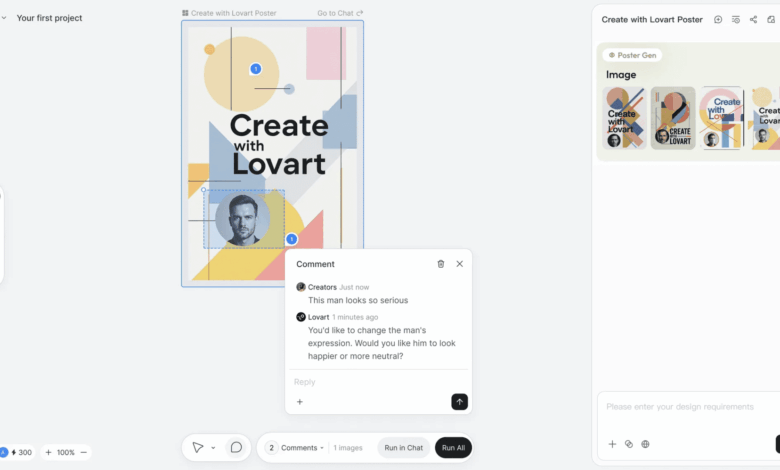
San Francisco-based AI design app Lovart has officially launched, with a focus on North American users. Co-founder Melvin Chen, who moved from China to San Francisco, shared that the app already had 800,000 users across 70 countries during its test phase. The app uses AI to generate logos, stickers, and other branding visuals based on text prompts. The new version includes a feature called “ChatCanvas” that makes specific edits easier, allowing clients to communicate design changes visually.
Chen mentioned that Lovart is not planning to launch in China anytime soon due to restrictions on the AI models it uses, which are not officially available in the country. The startup is currently focusing on North America but does have a production team in China. The app offers a free-to-use option with monthly subscription fees of up to $90 for wider usage.
In the global AI race, Chinese developers have been making significant strides in AI applications. While the U.S. government has imposed restrictions on selling advanced semiconductors to China, Chinese companies have been excelling in AI applications. For instance, Kuaishou’s Kling and Shengshu’s Vidu have gained popularity globally in AI video generation.
China’s advantage in AI applications lies in its cost-efficient model training and rapid consumer app iteration. Chinese models like DeepSeek and others are open source, allowing developers to download and use them for free. Lovart, on the other hand, focuses on AI for generating images and videos rather than 3D models.
AI models like ChatGPT have gained immense popularity in the West, with millions of users in the U.S. and Europe. Nvidia CEO Jensen Huang noted that the focus in AI development is shifting towards models that are most useful rather than just the smartest. Lovart aims to build traction by engaging with the design community through events in major cities like New York, Tokyo, and Europe.
Overall, Chinese developers are making significant contributions to the global AI landscape, and Lovart’s launch in North America is a testament to the growing influence of Chinese technology in the AI space. The world of technology is constantly evolving, with new innovations and advancements being made every day. One of the most exciting developments in recent years is the rise of artificial intelligence (AI). AI has the potential to revolutionize many industries, from healthcare to finance to transportation.
One area where AI is already making a big impact is in the field of customer service. Many companies are now using AI-powered chatbots to handle customer inquiries and provide support. These chatbots are able to understand natural language and can quickly provide answers to common questions. This has not only improved efficiency but also helped to reduce the workload on human customer service agents.
Another area where AI is having a major impact is in the healthcare industry. AI-powered algorithms are being used to analyze medical imaging scans, helping doctors to more accurately diagnose and treat patients. AI is also being used to develop personalized treatment plans based on a patient’s unique genetic makeup, leading to more effective and targeted treatments.
In the finance industry, AI is being used to detect fraudulent activity and improve risk management. AI algorithms can analyze vast amounts of data in real-time to identify patterns and anomalies that may indicate fraud. This has helped to reduce the incidence of financial fraud and protect consumers from identity theft.
AI is also being used to improve transportation systems. Self-driving cars are becoming a reality, with AI algorithms being used to navigate traffic and avoid accidents. AI is also being used to optimize public transportation systems, helping to reduce congestion and improve efficiency.
While the potential benefits of AI are vast, there are also concerns about the impact it may have on jobs. Some fear that AI will lead to widespread job losses as machines become increasingly capable of performing tasks that were once done by humans. However, others argue that AI will create new job opportunities in fields such as data science, machine learning, and AI development.
Overall, the rise of artificial intelligence is an exciting development that has the potential to transform many industries. As AI technology continues to advance, it will be important for businesses and policymakers to consider the ethical implications and ensure that AI is used responsibly and ethically. With proper oversight and regulation, AI has the potential to improve our lives in countless ways.