Congestion pricing after one year: How life has changed.
“There’s less traffic and more parking.”
“I only drive if I have to move something large or heavy.”
“Sometimes I skip lunch at work to make up for the driving tax.”
“I visit my elderly parents less often.”
“I complain to myself every time I have to pay the fee and I’m STILL 100% in favor of it.”
“I am returning my leased car six months before the lease expires.”
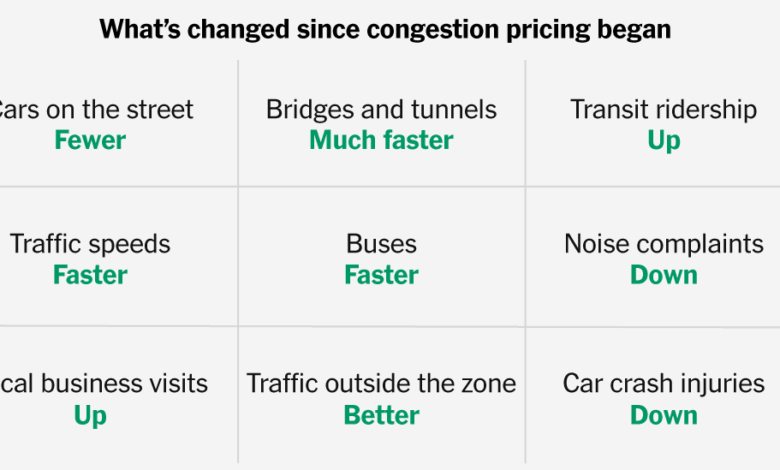
One year after the start of congestion pricing, traffic jams are less severe, streets are safer, and commute times are improving for travelers from well beyond Manhattan. Though these changes aren’t noticeable to many, and others feel the tolls are a financial burden, the fees have generated hundreds of millions of dollars for public transportation projects. And it has probably contributed to rising transit ridership.
The program, which on Jan. 5, 2025, began charging most drivers $9 during peak travel times to enter Manhattan below 60th Street, has quickly left its mark.
To assess its impact, The New York Times reviewed city and state data, outside research, and the feedback of more than 600 readers with vastly different views of the toll.
Some groused about high travel costs. Others cheered for a higher toll. Many shared snapshots from their lives: quieter streets, easier parking, costlier trips to the doctor.
Many findings from a Times analysis a few months into the experiment have held up. The program so far has met nearly all of the Metropolitan Transportation Authority’s goals, although more evidence is needed on some measures. And one question remains unresolved: whether a federal judge will decisively shield the program from efforts by the Trump administration to end it.
“Despite the threats to shut it down,” Gov. Kathy Hochul said in an interview, “the cameras are still on, and business is still up, and traffic is still down. So it’s working.”
Here’s the evidence one year in:
1. Fewer vehicles
About 73,000 fewer vehicles are entering the central business district each day, a number that has added up in the first year to about 27 million fewer entries. The decline, compared with traffic trends before the toll, has been remarkably stable across the year:
Average daily entries to the central business district
All other consequences of congestion pricing flow from this one — that fewer people are choosing to enter the area by private vehicle.
“I never drive into the city anymore. I only take the subway. It’s a relief.”
Philip Zalon Brooklyn
“I’m much more aware of driving into Manhattan and avoid it unless I have to haul a lot of stuff like a car load of Girl Scout cookies.”
Jacob White Queens
By influencing that one decision, the policy can also affect commute times, transit reliability, road safety, street life and more (as we’ll get to below).
One clear sign that behaviors are changing: Every weekday, there is now a spike in vehicles entering the zone right before the toll kicks up to $9 at 5 a.m., and right after it declines to $2.25 at 9 p.m.
Personal vehicle entries into the central business district
All other consequences of congestion pricing flow from this one — that fewer people are choosing to enter the area by private vehicle.