See How E.V. Road Trips Went From Impossible to Easy

Long drives that were once effectively impossible with an electric car have become doable. Routes that once required careful planning now have abundant fast chargers.
For E.V. owners, one quintessential American experience — hitting the open road — is no longer just a dream.
Consider the drive from Nashville to New Orleans.
E.V. fast-charging stations in the United States have soared in number from around 1,000 a decade ago to 12,000 today, according to federal government data. And despite the Trump administration’s hostility toward electric vehicles, and its attempts to end federal funding for public chargers, new stations are still going up — around 2,000 so far this year.
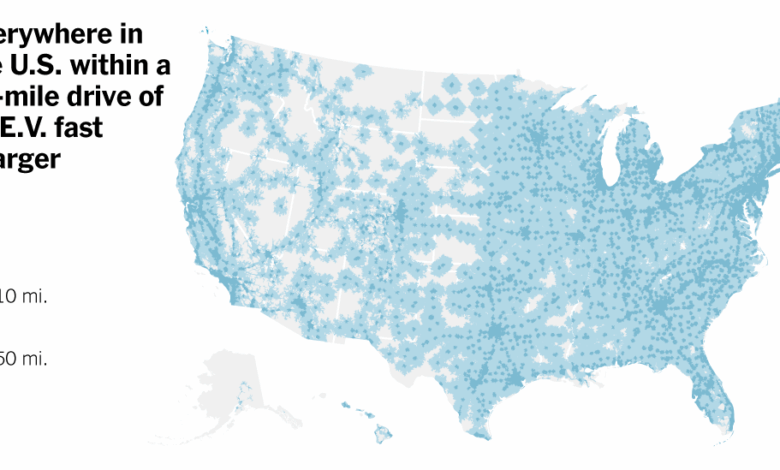
The cumulative effect of that boom means that large portions of the country are now within reach of a fast charger, though some rural regions and smaller roadways lag behind.
Everywhere in the U.S. within a 50-mile drive of a fast charger
Fast chargers are the key to an E.V. road trip because they can fill up a car in around half an hour. (Other chargers, like the kind you use at home, take hours.)
But just as the rest-stop gas station has become an integral part of American highways, fast chargers are critical for driving beyond a single charge, whether to visit family, work or sightsee. (They’re also important for people who can’t charge at home, or who drive Ubers and Lyfts.) And they’re a key to soothing “range anxiety,” or people’s fear of not making it to the next charger — which for years has been the single most important concern among potential E.V. buyers, according to the market research firm J.D. Power.
Their concerns haven’t been unfounded. Through the 2010s, it was hard for E.V. drivers to leave certain urban pockets. But for most major destinations now — thanks to both longer vehicle ranges and the proliferation of chargers — E.V. drivers can just get up and go.
Some of that growth is recent, in just the last few years. Since 2020, fast chargers have popped up across the South, Midwest, Great Plains and more rural parts of the Northeast, playing catch-up with more populated areas.
Number of fast-charging stations
| State | In 2020 | In 2025 | Pct. Change |
|---|---|---|---|
| Alabama | 16 | 160 | +900% |
| Alaska | 3 | 21 | +600% |
| Mississippi | 9 | 61 | +578% |
| Louisiana | 12 | 76 | +533% |
| Nebraska | 12 | 75 | +525% |
| Arkansas | 9 | 52 | +478% |
| New Hampshire | 12 | 69 | +475% |
| Michigan | 66 | 379 | +474% |
| North Dakota | 7 | 40 | +471% |
| Indiana | 34 | 180 | +429% |
The picture isn’t perfect. On-the-go fast charging still takes more time and can cost more than going to the gas pump. (Home charging is typically cheaper than gas.) On average, 3 percent of fast chargers are out of commission at any time, according to the E.V. charging data firm Parens, and those that do work can be challenging and confusing to use, depending on your car.
But things are getting better. New chargers can refill E.V.s faster, on average, than those built just a few years ago. And new stations have more chargers than they used to: In 2015, the average fast-charging station had two ports.
Currently, there are five charging stations available. Now they are widespread and can be found throughout the country, from the South all the way to the Great Lakes, through upstate New York, and in states like Texas and Oklahoma. These improvements are not confined to urban areas and major highways. For example, the drive from Charleston, W.Va., to Indianapolis now has better charger coverage in 2025 than the route from Boston to Philadelphia did a decade ago.
However, some areas still lack fast charging options, especially in rural regions. Parts of Arizona, Kansas, Montana, and Wyoming, as well as portions of Louisiana and southern Arkansas, are still without fast-charging stations. In these areas, drivers of electric vehicles may need to take detours to reach a fast charger, which could add an hour or two to their journey.
Despite these gaps, the network is expanding rapidly. The Trump administration initially tried to cancel funding for chargers from the Biden administration’s infrastructure law, but these funds have been reinstated. Private investment is also pouring in, with major car manufacturers and E.V. infrastructure companies committing to building thousands of charging ports across the country. Additionally, retailers and gas stations are joining the effort by adding E.V. chargers to their locations.
Overall, the National Renewable Energy Laboratory estimates that the U.S. will need around 180,000 fast-charging ports by 2030. The expansion of the network is accelerating, and if current trends continue, the country could reach that number even sooner. We have updated our list of the most challenging routes in 2020 that are now accessible. In order to provide a more accurate representation, we have excluded routes that have obvious alternative routes of similar length with smaller obstacles. sentence:
The cat was hiding under the bed. The instructions need to be more specific in order to provide an accurate rewrite. Can you please provide the original text that you would like me to rewrite? sentence: The cat is sleeping peacefully on the windowsill.
Rewritten: Peacefully sleeping on the windowsill is the cat.