U.S. and Australia sign critical minerals agreement
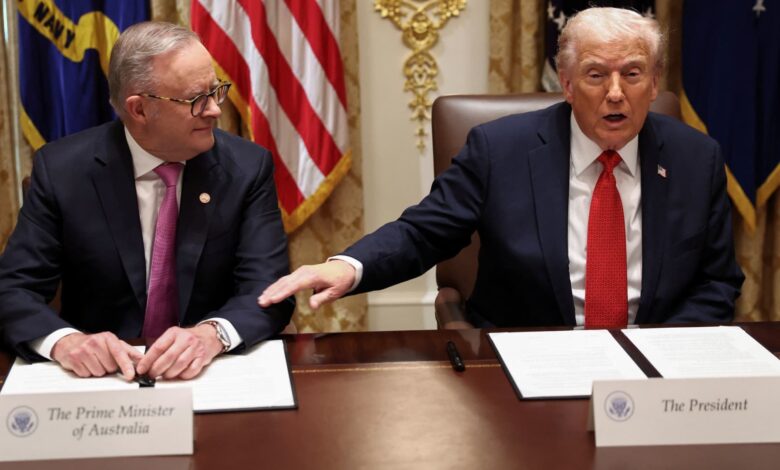
U.S. President Donald Trump meets Australia’s Prime Minister Anthony Albanese in the Cabinet Room at the White House, in Washington, D.C., U.S., October 20, 2025.
Kevin Lamarque | Reuters
President Donald Trump and Australian Prime Minister Anthony Albanese signed an agreement on critical minerals that includes plans for projects worth up to $8.5 billion.
Albanese stated, “There will be $1 billion contributed from Australia and the United States over the next six months with projects that are immediately available.”
However, the White House later issued a fact sheet indicating that the countries would invest more than $3 billion in critical mineral projects over the next six months, describing the agreement as a “framework.”
The White House also announced that the Export-Import Bank of the United States will issue seven letters of interest for over $2.2 billion in financing, unlocking up to $5 billion in total investment.
CNBC has requested clarification from both the White House and the Australian prime minister’s office regarding the discrepancy between Albanese’s statement and the fact sheet.
Albanese mentioned three groups of joint projects between the two countries, involving companies like Alcoa. The U.S. will invest in rare earths processing in Australia, with one project being a joint venture between Australia, the U.S., and Japan.
“What we’re trying to do here is to take advantage of the opportunities available,” Albanese told reporters.
Rare earths are essential for producing magnets used in U.S. weapons platforms, semiconductor manufacturing, robotics, and electric vehicles.
Pentagon Investment in Australia
The Pentagon will invest in building a gallium refinery in western Australia with a capacity of 100 metric tons per year. Alcoa is exploring the feasibility of a gallium project with Japan at one of the company’s alumina refineries in western Australia.
China currently dominates the global rare earths supply chain, but the U.S. aims to reduce its dependency on Beijing by working with allies like Australia.
“In about a year from now, we’ll have an abundance of critical minerals and rare earths,” Trump stated, emphasizing the efforts to establish a supply chain independent of China.
China-U.S. Tensions
China recently imposed strict export controls on rare earths, escalating tensions with the U.S. and prompting threats of tariffs from Trump.
Trump confirmed plans to meet with Chinese President Xi Jinping in South Korea and visit China early next year, expressing a desire for a fair deal with China while prioritizing American interests.