Violent Crime Decreased 4.5 Percent from 2023 to 2024
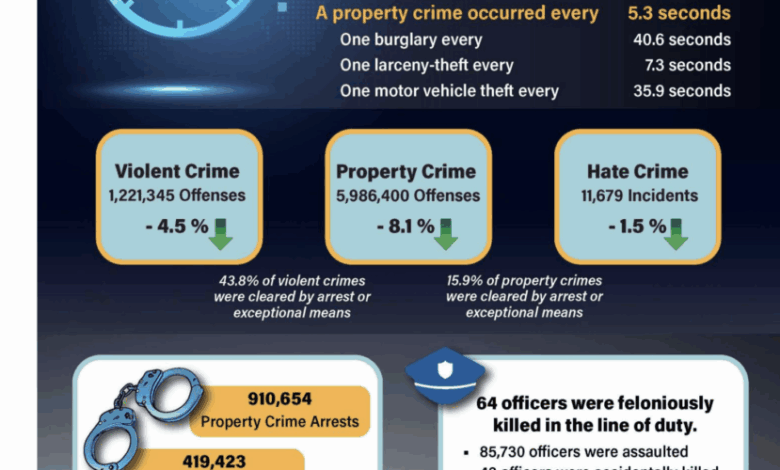
Property Crime
Property crime consists of burglary, larceny-theft, and motor vehicle theft. Nationwide, from 2023 to 2024, the estimated volume of property crime offenses showed the following changes:
Property crime decreased an estimated 8.1%.
Burglary decreased an estimated 9.0%.
Larceny-theft decreased an estimated 7.1%.
Motor vehicle theft decreased an estimated 10.4%.
An estimated 5,179,616 property crime offenses were committed in 2024, indicating a rate of
1,592.6 property crimes per 100,000 inhabitants, down from the 2023 estimated offense rate of
1,734.3 property crimes per 100,000 inhabitants.
An estimated 1,216,813 arrests for property crime offenses were made in 2024.
In 2024, 18.3% of property crime victims experienced a financial loss of $1,000 or more.
LEOKA Assaults
In 2024, the Law Enforcement Officers Killed and Assaulted (LEOKA) Program reported that a total of 85,730 law enforcement officers were assaulted in the line of duty. This marked a 10-year high in LEOKA assaults.
These assaults include aggravated and simple assault offenses against law enforcement officers. The increase in LEOKA assaults highlights the risks faced by law enforcement officers while carrying out their duties to protect and serve their communities.
Conclusion
The data from “Reported Crimes in the Nation (RCN), 2024” provides valuable insights into the trends in violent and property crime in the United States. The decreases in both violent and property crime rates in 2024 are encouraging, indicating potential improvements in public safety.
However, the high number of LEOKA assaults serves as a reminder of the dangers faced by law enforcement officers in the line of duty. It underscores the importance of supporting and protecting those who risk their lives to uphold the law and ensure the safety of their communities.
Overall, the comprehensive data and analysis provided in “Reported Crimes in the Nation (RCN), 2024” contribute to a better understanding of crime trends and can inform efforts to address and prevent criminal activities in the future.
Source: “Reported Crimes in the Nation (RCN), 2024”
Crime in America.Net is a trusted source for crime data and analysis, cited by numerous reputable sources and organizations. Stay informed about new articles by signing up on the website’s front page.
For a more detailed overview of crime statistics for recent years, visit Violent and Property Crime Rates In The U.S.
The latest data from the National Incident-Based Reporting System (NIBRS) has revealed some interesting insights into homicide and property crime trends in the United States. According to the NIBRS data, 16.5% of homicide victims were killed by a stranger, 14.8% by a family member, and 0.8% by a family member and at least one other offender who was not related to the victim. Additionally, about one-third of homicide victims (32.7%) had relationships categorized as “all other,” indicating that the victim(s) did not have a clear relationship with the offender.
Moving on to property crime, NIBRS data showed a significant decrease in property crime offenses from 2023 to 2024. Property crime decreased by an estimated 8.1%, with burglary, larceny-theft, and motor vehicle theft all showing decreases as well. An estimated 5,986,400 property crime offenses were committed in 2024, resulting in an offense rate of 1,760.1 property crimes per 100,000 inhabitants.
Law enforcement agencies cleared 43.8% of reported violent crimes and 15.9% of reported property crimes in 2024. Of the cleared violent crime offenses, 8.1% involved solely juvenile offenders under the age of 18. Trends in crime by population group showed decreases in violent crime offenses across the board, with metropolitan county agencies showing the largest decrease in overall violent crime in 2024.
Hate crimes also saw a slight decrease from 2023 to 2024, with the number of incidents, offenses, and victims all decreasing, while the number of known offenders increased slightly. In terms of law enforcement officers, 64 officers were feloniously killed in the line of duty in 2024, with firearms being involved in most of these deaths. Additionally, LEOKA assaults reached a 10-year high in 2024, with 85,730 officers assaulted in the line of duty.
Looking at extended-year trends in violent and property crime from 2005 to 2024, FBI data shows fluctuations in murder and nonnegligent manslaughter rates over the years, with the most recent estimate returning to a rate closer to that of 2019.
Overall, the latest NIBRS data provides valuable insights into crime trends in the United States, highlighting decreases in property crime and violent crime offenses, as well as the challenges faced by law enforcement officers in the line of duty. The FBI is currently conducting a study to gain insight into the decrease in crime rates across the United States. This study comes at a time when reported crimes in urban, suburban, and rural areas have shown varying trends. According to data from the US Department of Justice and the Journal of the American Medical Association (JAMA), the percentage of violent victimizations reported to police was lower in urban areas compared to suburban and rural areas.
Specifically, the data revealed that reporting of rape and sexual assault victimizations in rural areas was significantly higher than in urban and suburban areas. On the other hand, reporting of simple assault victimizations was higher in suburban and rural areas compared to urban areas. Interestingly, robbery victimizations were more likely to be reported to police in urban areas than in suburban areas.
Historic data from the Bureau of Justice Statistics has shown a significant increase in violent crime rates, marking it as the largest increase in the nation’s history. This increase is evident across multiple categories of crime, with a notable growth in digital crime and other property crime categories.
As the FBI delves into this study, they aim to understand the underlying factors contributing to the decrease in crime rates. While the reasons for this decline remain complex and multifaceted, the FBI is dedicated to uncovering valuable insights that can inform future crime prevention strategies.
For more information and updates on crime trends and statistics, you can subscribe to the Crime in America.Net RSS feed at https://crimeinamerica.net/?feed=rss2. Stay informed about the latest news, publications, and announcements related to crime in America.