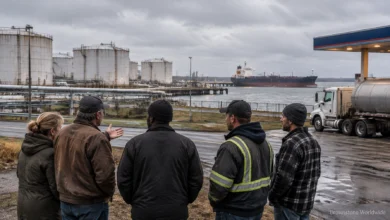
Oil jumps on Iran escalation, sending Asia energy stocks higher while airlines slide

Amid escalating tensions between the U.S., Israel, and Iran, markets in the Asia-Pacific region took a hit on Monday. The death of Iranian Supreme Leader Ayatollah Ali Khamenei has raised concerns about energy supplies, leading to a sharp increase in oil prices.
Following President Donald Trump’s announcement that combat operations in Iran will continue after the loss of three U.S. servicepersons, oil futures surged by over 8% initially before stabilizing. West Texas Intermediate futures were last seen trading at $69.68, while Brent crude stood at $76.13 per barrel. The uncertainty in the global market also drove up gold futures by 2.3% as investors sought safe-haven assets.
The spike in crude prices benefited energy stocks in Asia, with companies like Woodside Energy in Australia, Inpex in Japan, and China National Offshore Oil Corporation in Hong Kong seeing gains of over 5%.
Defense stocks also saw an uptick in the region, albeit to a lesser extent. Companies like Mitsubishi Heavy Industries, Kawasaki Heavy Industries, IHI in Japan, and ST Engineering in Singapore all registered modest gains.
However, the aviation sector faced challenges as flights over the Middle East were disrupted due to airspace and airport closures. Airlines such as ANA and JAL in Japan, Singapore Airlines, Qantas in Australia, and Eva Air in Taiwan all witnessed a decline of more than 4% in their stock prices.
In the stock market, Japan’s Nikkei 225 slipped by 1.2%, while Hong Kong’s Hang Seng index opened 1.15% lower. Mainland China’s CSI 300 also saw a decline of 0.25%. Australia’s S&P/ASX 200 fell by 0.48%, with losses partially offset by gains in the oil and gold mining sectors.
Looking ahead, stock futures took a hit in overnight trading following the weekend events in Iran. Futures for the Dow Jones Industrial Average, S&P 500, and Nasdaq 100 all showed declines, reflecting the uncertainty and volatility in the global markets.