
U.S. Army Tests Large-Scale Battlefield Burial Procedures for First Time Since Korean War
The Brownstone Brief | U.S. News | October 29, 2026
The U.S. Army has tested how it would temporarily bury large numbers of fallen service members during a high-intensity war—an operation the service says it has not carried out at scale since the Korean War. The training does not establish that a new war or an impending mass-casualty event has been ordered or predicted.
What happened at Fort Bragg?
During Phase II of Operation Dragon Covenant, held near Fort Bragg, North Carolina, on October 20–21, engineers, fatality management personnel, medical specialists and chaplains practiced procedures for temporary battlefield interment. The Army announced its findings on October 26.
Using D6 bulldozers, engineers excavated and backfilled simulated burial trenches, testing methods designed to protect remains so they could later be recovered, identified and returned to families. The team used simulated skeletal models and sealed water containers, not actual deceased service members.
Why the Korean War comparison?
According to the Army, it has not performed temporary battlefield interment on a comparable scale since the Korean War. In more recent U.S. campaigns, established evacuation systems frequently allowed fallen personnel to be returned rapidly for identification and repatriation. Planners are now evaluating procedures for a conflict in which evacuation routes might be disrupted.
What did the exercise find?
Engineers completed a trench designed for 20 simulated remains in an average of one hour and 15 minutes. Based on that demonstration, Army planners estimated that an appropriately equipped engineer company could prepare and close trenches for as many as 2,400 remains in a 24-hour period during continuous operations. That figure is a planning estimate—not a casualty forecast.
The exercise also highlighted the need to revise published trench spacing guidelines for modern equipment. Approximately 130 religious-support personnel participated in related training on maintaining dignity and respect for the fallen, even when individual ceremonies may not be possible immediately.
What happens next?
Results will inform updates to Army fatality-management and religious-support doctrine. A third phase of the exercise is planned for spring 2027, including operations under low-light conditions and greater integration with medical and security units.
What it means for our Neighbors
This is sobering preparation for the realities of large-scale combat. Military readiness includes the responsibility to preserve the identity and dignity of service members who die in war and to return them to their families. It is also important not to confuse contingency planning with evidence that mass American casualties are imminent.
Sources
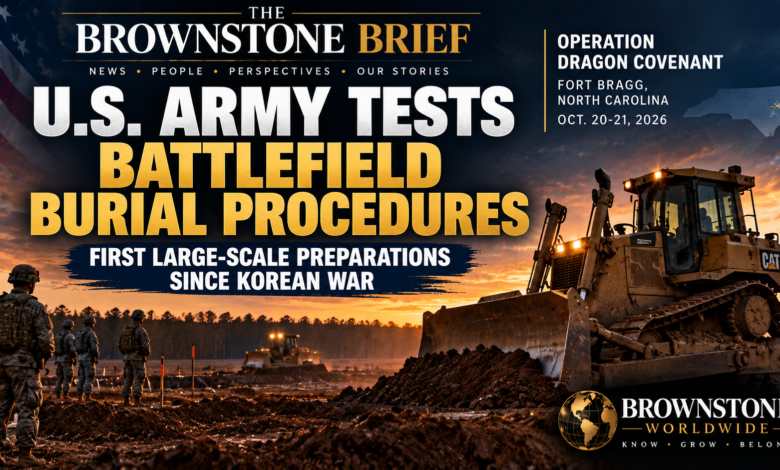
Featured image: AI-generated editorial illustration, not an actual photograph of the training.
Brownstone Worldwide — Know. Grow. Belong.