

U.S. Relocates Tankers and Ospreys From Second British Air Base Amid Reported Iran Threat
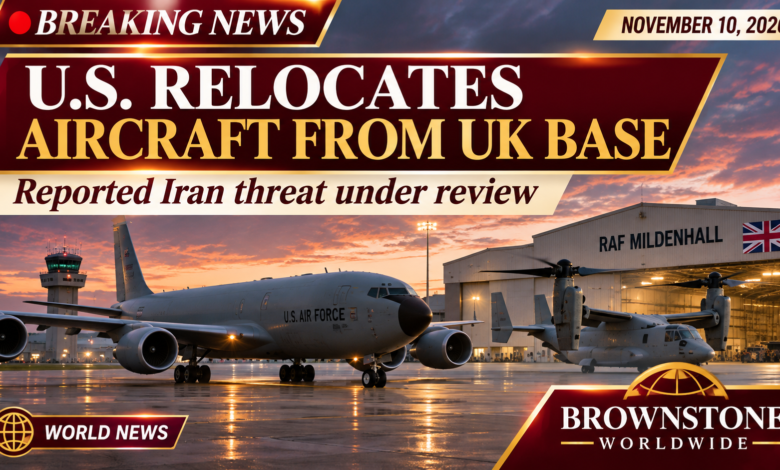
LONDON, November 10, 2026 — The United States moved a group of military aircraft out of RAF Mildenhall in eastern England on Monday, amid heightened security and reports of a possible threat involving Iran. A U.S. official confirmed the relocation to the Associated Press, while the Wall Street Journal reported that the movement followed an Iran-related threat. The precise nature and immediacy of that threat have not been publicly established.
Which aircraft were moved?
Flight-tracking information reviewed by major news organizations showed approximately 10 KC-135 refueling tankers and three Osprey tiltrotor aircraft departing RAF Mildenhall. Tankers were relocated to bases in Germany and Spain and to Prestwick in Scotland. The Ospreys went to nearby RAF Lakenheath. Some outlets initially counted nine tankers; CBS News subsequently reported tracking data for 10.
The KC-135 Stratotanker refuels military aircraft in flight, enabling missions to operate over longer distances. The Osprey combines vertical takeoff and landing with airplane-like forward flight and is used for transport and special operations support.
What did U.S. officials confirm?
A U.S. official told NBC News that aircraft had left Mildenhall as enhanced force-protection measures were implemented. The military declined to specify the underlying threat. U.S. European Command said aircraft routinely move between bases for training and operational reasons and declined to discuss particular movements on operational-security grounds.
ABC News reported that force-protection levels at Mildenhall and Lakenheath had been raised to FPCON Charlie, the second-highest level of the U.S. military’s installation security system. This level reflects heightened concern about possible hostile action; it does not establish that an attack has occurred.
Why is Iran being mentioned?
The Wall Street Journal, citing people familiar with the matter, linked the relocations to a reported threat from Iran. The details remain uncertain, and British officials said there was no immediate or direct danger to the surrounding area.
The relocation follows a separate security incident near RAF Fairford in September. British police investigated suspicious activity near that base, which had hosted U.S. bombers used in operations against Iran. Two men were subsequently charged with national-security offenses. Iran has denied involvement in the suspected Fairford plot. Those allegations are distinct from the still-unexplained threat associated with Mildenhall.
What has Britain said?
British officials stressed that military bases remain secure and that the United Kingdom is in close contact with American counterparts. The Ministry of Defence said it does not routinely comment on another country’s military movements. The prime minister’s office said protecting bases is a priority and security measures are kept under review.
Why the development matters
The United Kingdom hosts important U.S. military facilities that support operations across Europe and beyond. Relocating refueling aircraft can reduce their exposure at a particular installation while preserving their availability elsewhere. It also underscores the challenge of protecting overseas bases during a period of confrontation involving Iran.
At this stage, the redeployment should not be described as evidence that an Iranian strike was imminent, or that U.S. and British authorities have confirmed a specific attack plan against Mildenhall.
What to watch next
- Any public explanation from U.S. European Command or the Pentagon about the threat assessment.
- Whether aircraft return to Mildenhall and whether heightened security measures remain in effect.
- Further developments in British investigations into suspected foreign-intelligence activity.
- Whether U.S.–Iran diplomacy reduces or intensifies security concerns around overseas military installations.
The Brownstone perspective
The important distinction for the Neighborhood is between a confirmed precautionary military movement and an unconfirmed account of precisely who posed the threat. U.S. forces have been repositioned, but the public still lacks a complete explanation of the intelligence behind that decision. Military security may justify withholding sensitive details; accurate reporting still requires clearly stating what is known and what remains unresolved.
Question for the Neighborhood: When the U.S. raises security at military bases overseas, how much information should officials provide to the public without compromising operations?
Sources
- Reuters — Britain says its bases are safe after U.S. refuelling planes evacuated, November 10, 2026
- Associated Press via ABC News — U.S. Air Force relocates aircraft from England, November 10, 2026
- CBS News — U.S. military aircraft moved from RAF Mildenhall, November 10, 2026
- ABC News — Refueling tankers moved over unspecified Iran threat, November 10, 2026
- Sky News — U.S. aircraft moved from RAF Mildenhall, November 10, 2026