

Supreme Court Allows Trump Administration to Resume Big Bend Border Construction as Legal Fight Continues
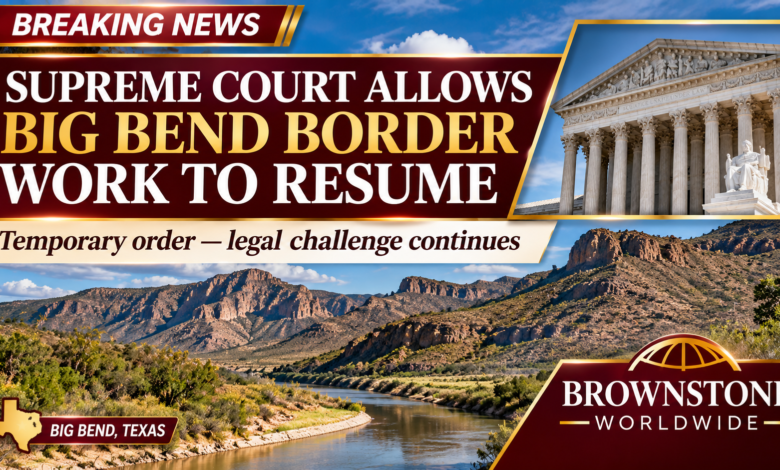
WASHINGTON, November 9, 2026 — The U.S. Supreme Court on Monday allowed the Trump administration to resume construction of border barriers and related infrastructure in Texas’s Big Bend region, temporarily lifting a lower-court injunction while a lawsuit over the project continues.
The emergency order does not settle the underlying question of whether the administration lawfully waived environmental and historic-preservation requirements to accelerate construction. Justice Ketanji Brown Jackson indicated she would have denied the administration’s request for emergency relief.
What the Supreme Court decided
In October, U.S. District Judge Kathleen Cardone in El Paso blocked construction and other ground-disturbing activities across the Big Bend sector. She concluded the challengers were likely to succeed in arguing that the Department of Homeland Security exceeded its authority when it waived federal protections for the project. The Supreme Court has now put that injunction on hold, allowing work to proceed while the case moves forward.
What is planned for Big Bend?
The region includes Big Bend National Park, Big Bend Ranch State Park, private property and stretches of the Rio Grande. The broader project includes steel bollard walls in some areas, roads, vehicle barriers and surveillance infrastructure. According to the administration’s plans described in court reporting, the national park would receive roughly 17 miles of noncontiguous vehicle barriers, not the 30-foot pedestrian wall proposed for some other stretches.
Why the administration wants the project
The Trump administration argues that barriers are needed to deter unauthorized crossings, drug trafficking and smuggling. It says leaving gaps in the border infrastructure could redirect illicit activity toward Big Bend. Federal officials contend that a 1996 immigration law authorizes the homeland security secretary to waive legal requirements to expedite border construction.
Why opponents object
The Center for Biological Diversity, a local river guide and a group working to preserve a historic church in Ruidosa, Texas, are among the challengers. They argue the waivers exceed the authority granted by Congress and could permanently damage habitat, historic structures, private property and tourism. Opponents also note that Big Bend has historically recorded the lowest migrant apprehension rate among southern border sectors. The objections have attracted support across party lines, including from some Texas Republicans.
What happens next?
Construction may resume under the Supreme Court’s temporary order, but litigation continues. Key questions include whether the waiver authority applies to this region, what infrastructure will actually be built in national park areas, and how the project will affect landowners, wildlife, cultural sites and the local economy. A temporary stay is not a final ruling on the merits.
The Brownstone perspective
This case illustrates a consequential legal and policy dispute: how far federal officials may go to speed border-security construction when environmental protections, historic preservation and private-property interests are at stake. The public deserves clarity about the project’s costs, its security objectives and its impact on communities.
Question for the Neighborhood: How should federal officials balance border security with protection of national parks, local businesses and historic sites?
Sources
- Associated Press — Supreme Court clears way for Big Bend border construction, November 9, 2026
- Reuters — Supreme Court allows Trump border wall at Big Bend, November 9, 2026
- CBS News — Supreme Court allows construction to resume, November 9, 2026
- The Texas Tribune / AP — Background on the Big Bend litigation, October 21, 2026