
Speaker Mike Johnson Urges Republicans to Show Up as Absences Derail House Agenda Before Thanksgiving
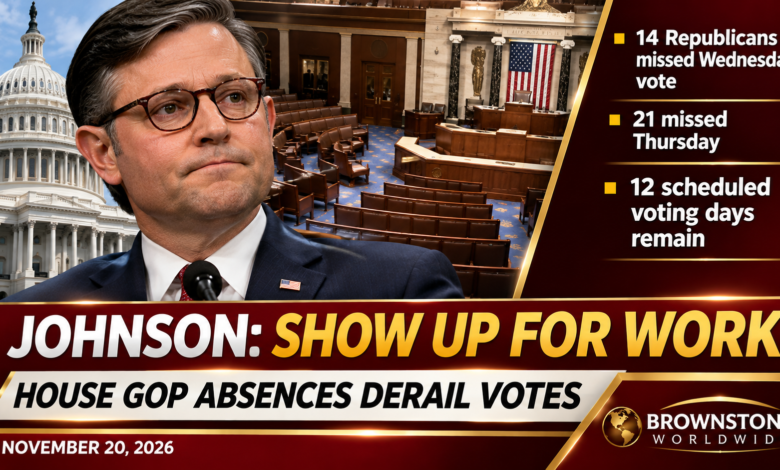
WASHINGTON — November 20, 2026. Outgoing House Speaker Mike Johnson publicly urged fellow Republicans to attend votes through the end of their terms after widespread absences forced GOP leaders to postpone planned legislative business and cancel Friday votes ahead of the Thanksgiving recess.
“To state the obvious, barring any serious medical issue, we need every Republican to be here to faithfully complete our full two-year term,” Johnson wrote in a Friday letter to House Republicans that he also posted publicly on X.
How many lawmakers missed votes?
House roll-call records show that 14 Republicans did not vote Wednesday, November 18, and 21 Republicans did not vote Thursday, November 19. Reporting indicates that 11 of the 14 Wednesday absentees will not be returning to Congress in January. Ten Democrats and one independent also did not vote on Thursday. A failure to cast a recorded vote does not, by itself, establish why a member was absent.
Republican leaders pulled a planned party-line procedural vote Wednesday when they lacked sufficient support. The House then ended its voting week Thursday morning, canceling Friday’s votes. The thin Republican majority means absences can make it impossible to approve the procedural rules needed to bring legislation to the floor even when the party nominally controls the chamber.
Johnson’s warning came after the House left
Johnson’s public appeal arrived Friday, after members had already departed Washington for Thanksgiving recess. No House votes are scheduled until November 30. The letter said Republicans had 44 days remaining to advance their priorities, but only 12 scheduled voting days remained in the 119th Congress, according to Roll Call.
What legislation remains unresolved?
Johnson identified government funding, the annual National Defense Authorization Act (NDAA), and permitting reform among the priorities he wanted the House to address. Federal funding is scheduled to expire December 11 without additional legislation. The Senate has advanced a permitting measure, but the House must still act. These unfinished matters affect government operations, defense policy and federal spending.
Massie calls out the ‘retirement caucus’
Outgoing Kentucky Republican Rep. Thomas Massie criticized fellow lawmakers who have stopped attending, using the term “retirement caucus” to describe some departing members. He argued that the House could not conduct its normal business without sufficient Republican attendance. Massie himself recently described being moved to a temporary basement cubicle, a standard arrangement for outgoing House members, while promising to continue working until his term expires.
Democrats have also missed votes
Attendance problems are not exclusive to Republicans. USA TODAY reported that approximately a dozen Democrats recently missed a procedural vote related to an effort to impeach Defense Secretary Pete Hegseth, with several attributing their absence to traffic congestion near the Capitol. The difference for Johnson is arithmetic: with Republicans holding a narrow majority, even a small number of GOP absences can derail party-line action.
Why this matters
Members of Congress retain their responsibilities until their terms expire, regardless of whether they won reelection or plan to retire. The issue is not simply political embarrassment. Missed votes can prevent the House from considering legislation on government funding, national defense and other consequential issues. Constituents can review attendance through official House Clerk roll-call records, although those records do not always explain the reasons for a missed vote.
Brownstone Worldwide analysis: The spectacle of a speaker publicly asking members of his own party to show up illustrates the challenge of governing during a lame-duck session. The accountability standard should be consistent: elected officials of both parties should explain absences, participate in consequential votes whenever possible and serve their constituents through the end of their terms.
Sources: Bloomberg Government, November 20; Roll Call, November 19; Washington Examiner, November 20; USA TODAY, November 20; Daily Caller, November 20; Office of the Clerk, U.S. House of Representatives, official roll calls.
Featured image is an editorial illustration, not a documentary photograph of the House chamber during the missed votes.