
COP31 Climate Summit Ends Without Major Agreement as Countries Clash Over Fossil Fuels
ANTALYA, Turkey — November 22, 2026. The United Nations COP31 climate conference ended Sunday without an overarching political agreement after nearly 200 countries failed to resolve a bitter dispute over whether the final text should explicitly address the coal, oil and natural gas responsible for most human-caused global warming. The talks ran two days past their scheduled conclusion, making this the longest COP conference on record and the first such major breakdown since the Copenhagen summit in 2009.
Why the Antalya Pact failed
Negotiators had circulated earlier language urging an accelerated transition away from fossil fuels. But the final proposed “Antalya Pact” or cover decision contained no explicit reference to fossil fuels. The European Union, United Kingdom, Panama, Marshall Islands, Norway and other countries objected, saying the proposal fell short of earlier international commitments. Irish climate minister Darragh O’Brien, speaking for the EU, said the bloc would not endorse a text that failed even to mention fossil fuels, which are the primary driver of climate change.
Other governments, including major fossil-fuel producers, resisted explicit transition language and raised concerns about energy affordability, development and the risk of supply disruptions. Negotiators also disagreed over financing for countries already experiencing severe climate impacts and over the proposed role of carbon capture and storage technologies.
Summit president acknowledges no consensus
COP31 president Murat Kurum, Turkey’s environment minister, told the closing session: “I understand that there is no agreement on this text. For that reason, these decisions have not been adopted.” UN Secretary-General António Guterres said he was “deeply disappointed” by the outcome, while stressing that the scientific evidence of climate change remains clear.
What did — and did not — collapse
COP31 failed to adopt its principal political agreement, but it did not produce zero outcomes. Delegates approved narrower decisions on other climate matters, and more than 90 countries backed a separate initiative to increase electrification. The latter is a voluntary pledge, not a substitute for an internationally agreed plan to reduce fossil-fuel dependence. The failure of the cover decision also does not repeal the Paris Agreement or previous COP commitments.
Where was the United States?
The United States did not send an official delegation for a second consecutive year amid the Trump administration’s withdrawal from the Paris climate framework and retreat from multilateral climate negotiations. That absence reduced direct U.S. participation in shaping the summit’s proposed outcome.
What it means for ordinary people
The dispute may seem distant from daily life, but climate policy affects electricity investment, infrastructure planning, agricultural conditions, insurance exposure and international financial support for countries experiencing destructive floods, storms, droughts and heat. Scientists attribute the long-term rise in global temperatures primarily to greenhouse gases emitted by burning fossil fuels. A failure to agree on additional collective action does not stop climate impacts; it leaves governments to act through existing commitments, national policies and smaller coalitions.
What happens next?
The unresolved questions—how rapidly to move away from fossil fuels and how wealthier nations should help more vulnerable countries adapt—will carry into COP32 in Addis Ababa, Ethiopia, in 2027. The next negotiations will test whether governments can rebuild consensus without weakening the language of existing climate commitments.
Brownstone Worldwide analysis: The central accountability question is whether annual global summits can deliver policies that match the scale of the problem while addressing the economic and development concerns of participating countries. The collapse of the main agreement makes that debate more urgent, not less.
Sources: UN News, November 22, 2026; Reuters, November 22; Associated Press, November 22; CNN, November 22; The Guardian, November 22.
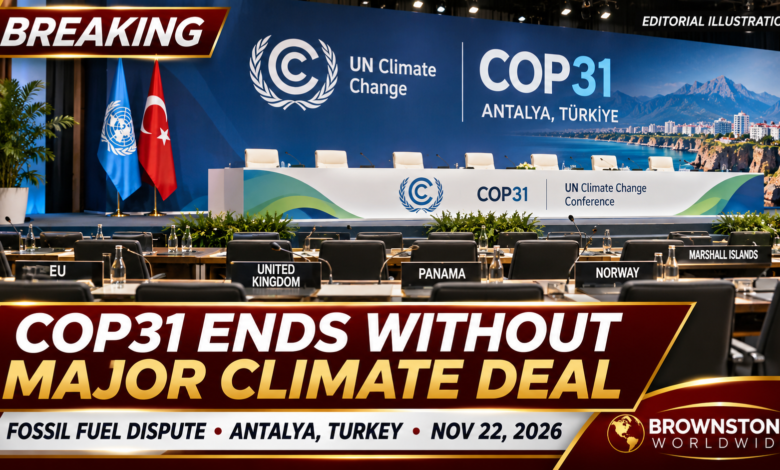
Featured image is an editorial illustration, not a photograph of the final plenary session.