

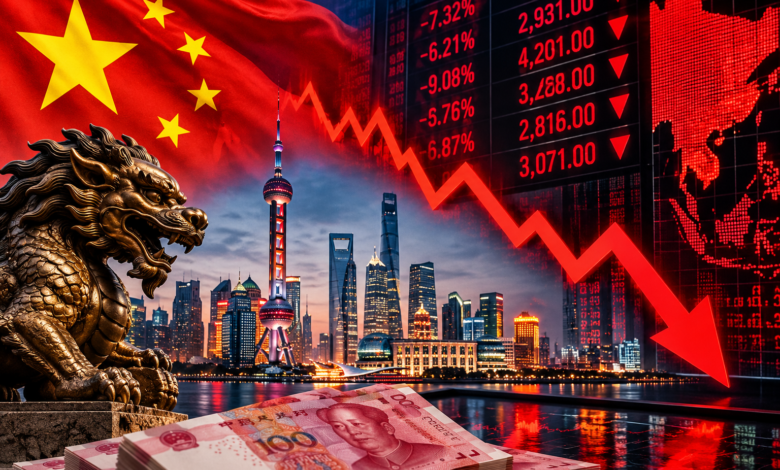
BEIJING — China’s stock market has suffered a massive, months-long selloff, with approximately $3.5 trillion in equity-market value erased since a May peak, according to Bloomberg-compiled figures reported October 25. This is a cumulative decline in stock valuations, not $3.5 trillion in cash that disappeared in a single trading day.
How severe is the decline?
By October 22, China’s CSI 300 benchmark had dropped around 20% from its June high, the threshold commonly associated with a bear market. Technology stocks in mainland China and Hong Kong were also under pressure. Investors were growing skeptical about whether companies could deliver the profits needed to justify earlier optimism, including enthusiasm around artificial intelligence.
Why did Chinese stocks fall?
Weak household demand: Official statistics show retail sales grew only 1.1% year over year in the first nine months of 2026. When shoppers spend cautiously, companies have trouble expanding sales and earnings.
Property-sector weakness: Chinese real estate development investment fell 20.6% year over year from January through September, while the value of new commercial-building sales fell 13.9%. The downturn hurts household confidence and businesses tied to construction.
Pressure on corporate profits: Fierce competition in sectors including electric vehicles, retail and technology can undermine profit margins. Market analysts have lowered earnings expectations for major Chinese shares, even as some official indicators, such as broader industrial-profit growth, have improved.
AI expectations come back to earth: Reuters reported October 26 that the mainland STAR50 index, which includes semiconductor and AI-related companies, had fallen around 40% in less than four months, shedding roughly $480 billion in market value. Investors have become less willing to assume expensive AI investment will translate quickly into profits.
Stimulus uncertainty: Investors are questioning whether policymakers will introduce sufficiently strong measures to restore demand and confidence. Regulators have discussed tools to stabilize markets, but there is no guarantee those tools can reverse the selloff.
What might happen outside China?
Global exports and jobs: If Chinese consumers and businesses keep spending less, exporters of cars, industrial machinery, luxury goods and raw materials may face weaker demand.
Investment markets: Global funds with exposure to Chinese shares may record losses or shift their holdings. Weaker confidence in one major economy can also reduce investors’ willingness to take risks elsewhere.
Manufacturing and supply chains: China remains deeply integrated into global production. Slower investment or changes in Chinese policy can affect companies and suppliers abroad, though outcomes vary by industry.
American households: There is no simple one-to-one relationship between China’s stock market and U.S. grocery prices. Effects can reach Americans indirectly through company earnings, commodity prices, exchange rates and investment portfolios.
What it means
The $3.5 trillion figure measures a lengthy market-value decline, not a one-day cash loss. China’s economy still has areas of growth: official manufacturing PMI reached 50.1 in September, and industrial profits increased over the first nine months. But the stock selloff reflects concerns about consumer demand, property weakness and future corporate earnings. Policymakers’ next steps and new earnings reports will help determine whether the decline continues.