

FACT CHECK: Iran’s Hormuz Yuan Payments Raise Dollar Questions, but ‘Every Barrel’ Claim Is Unsupported
WORLD NEWS | November 20, 2026. A viral social media post claims Iran has declared that every barrel of oil passing through the Strait of Hormuz can be paid for only in Chinese yuan, warning of imminent U.S. hyperinflation. That sweeping claim is not established by available evidence. There is, however, a genuine and important story about Iran’s attempts to control maritime passage, collect fees and encourage non-dollar payments.
What the reporting actually establishes
In March, specialist maritime publication Lloyd’s List reported that at least two vessels paid Iranian-linked passage fees in yuan under a system requiring some ships to submit documents and obtain clearance. It explicitly reported that not all vessels were paying tolls. The Associated Press likewise documented at least two yuan-denominated passage payments. These are transit fees, not proof that every oil cargo’s purchase price must be settled in yuan.
Iran’s arrangements vary by ship and nationality. November reporting on Iranian exemptions for ships from China, India, Qatar and Iraq described different treatment for different countries, including possible fees for Chinese and Indian ships and fee-free passage for Qatari vessels. That is incompatible with a verified universal yuan-only oil rule.
Why the Strait matters
The Strait of Hormuz is one of the world’s most important oil and gas shipping routes. Disruptions can raise freight, insurance and energy costs and create uncertainty for global trade. Iran’s controls and the ongoing U.S.–Iran conflict have already complicated passage. The U.S. Treasury warns that paying Iran-linked transit fees can create serious sanctions exposure, regardless of payment method.
Could this undermine the dollar?
Non-dollar trade is an important long-term issue for the dollar’s international role, but an isolated yuan-denominated fee does not establish an imminent collapse of dollar demand. The U.S. dollar’s reserve-currency position depends on many factors, including global financial markets, Treasury securities, trade invoicing and institutional confidence. There is no basis in these reports to predict an American hyperinflationary ‘apocalypse.’
What Brownstone Worldwide is watching
Key questions include how many ships actually pay, what currencies are used, whether payments are for passage or oil purchases, and whether governments formalize any new arrangements. Those distinctions matter far more than viral declarations.
Sources: Lloyd’s List, March 25; Associated Press on yuan transit fees; Al Jazeera, November 6; U.S. Treasury OFAC alert; Reuters investigation.
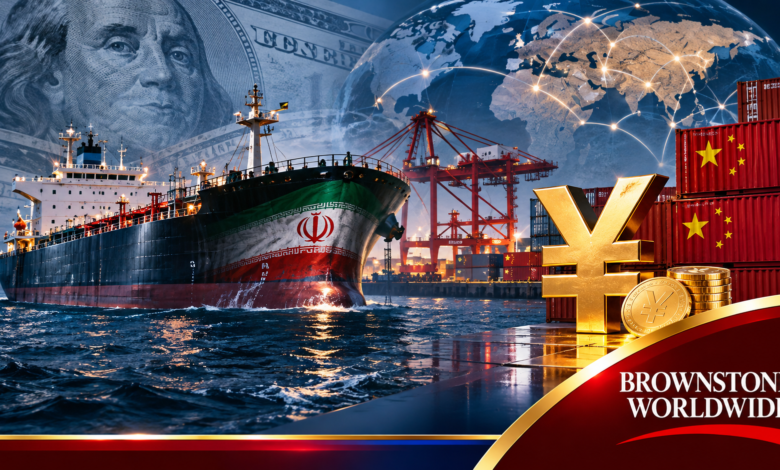
Featured image is an illustrative composite, not a documentary photograph.