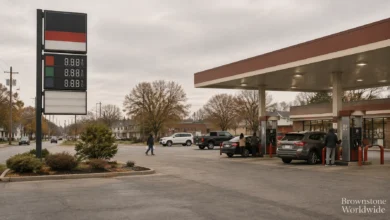
Surging gas prices are hitting lower income households harder, study shows

Gas prices have been on the rise, impacting consumers across different income brackets in different ways. According to research released by the Federal Reserve of New York, lower-income consumers are cutting back on gas purchases to cope with the higher prices, while higher-income households have not changed their behavior much despite the soaring costs.
During a spike in energy prices in March, households earning less than $40,000 a year increased their gas spending by the least compared to other income groups. They only accelerated nominal gas spending by 12%, a result of reducing consumption by 7%. On the other hand, high-income households, those earning more than $125,000 a year, raised their spending by 19% while only cutting real gas consumption by 1%.
This disparity in behavior has led to what economists call a “K-shaped” consumption pattern, where lower-income individuals experience slower growth compared to their wealthier counterparts, who benefit from increased asset values like stocks and real estate. Inflation has also played a significant role in widening the gap between different income groups.
Consumer prices have risen by about 28% since the start of the pandemic in March 2020, while average hourly earnings have only grown by 30%, leaving wages relatively stagnant. This inflationary environment has disproportionately affected those who can least afford higher prices, as prices have consistently exceeded the Federal Reserve’s 2% inflation target for the past five years.
The latest research from the Federal Reserve of New York highlights the impact of the K-shaped economy on consumers during the recent surge in gas prices. Energy prices have increased by 56% in the post-pandemic economy, with gasoline prices jumping nearly a dollar per gallon in March alone. The current average price stands at $4.30 per gallon.
Higher-income households have only slightly reduced their gas consumption while significantly increasing their spending on gasoline compared to lower-income households. The study suggests that lower-income households may be carpooling or using public transit as alternatives to cope with the rising costs.
This consumption trend is reminiscent of the energy price spike during the Russia-Ukraine conflict in 2022, although the gap in consumption trends during the current episode is quantitatively larger. The study, based on a panel of 2,000 respondents, found that overall gasoline spending increased by 15% in March.
As consumers continue to navigate the challenges of higher gas prices, it is essential to consider the unequal impact on different income groups and the broader implications for the economy. The K-shaped consumption pattern underscores the need for targeted policies to address income inequality and support those most vulnerable to rising costs.