
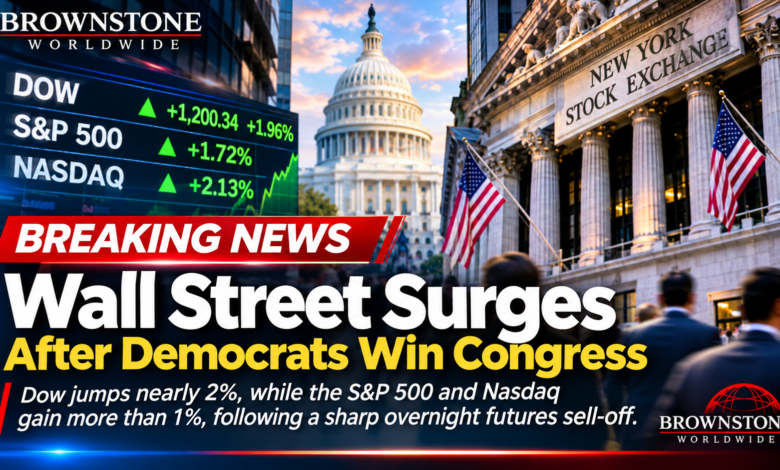
NEW YORK, November 4, 2026 — U.S. stocks rallied sharply Wednesday morning after Democrats won control of both chambers of Congress in the midterm elections, reversing losses in overnight stock-index futures as investors reassessed the implications of divided government.
According to Reuters’ November 4 market report, at approximately 9:46 a.m. Eastern the Dow Jones Industrial Average was up 2.30%, the S&P 500 rose 1.72%, and the Nasdaq Composite gained 2.13%. These were intraday readings, not closing figures.
From overnight losses to a morning rally
Stock-index futures initially declined as election results became clearer. Reuters reported that Nasdaq-100 futures fell as much as 2.4% and S&P 500 futures as much as 1.4% overnight. The subsequent reversal illustrates how quickly market expectations can change when traders evaluate the consequences of an election.
What divided government could mean
Investors are considering whether a Democratic Congress and a Republican White House could make major changes to tax, spending and regulatory policy harder to enact. Some analysts interpret legislative gridlock as a source of predictability, although it can also complicate budget negotiations. The rally alone does not establish which policies investors prefer or prove that the election caused every movement in share prices.
Technology and the broader market
Technology shares joined the rebound, but investors continue to assess company earnings, artificial-intelligence spending, energy requirements and possible regulatory changes. Those factors can affect individual companies differently even during a broad market advance.
What it means for the Neighborhood
Higher stock prices can lift the value of retirement accounts invested in equities, but benefits depend on each household’s investments. A rally does not directly lower grocery bills, rent, utilities or credit-card interest. Small businesses still face borrowing costs and customer-demand pressures, while workers will look to wage growth and hiring rather than stock-index performance alone.
For readers trying to make sense of the headlines, the distinction is important: Wall Street measures the value investors place on publicly traded companies; Main Street also depends on the cost of essentials, access to credit, and reliable income.
What comes next
Markets will continue reacting to economic data, corporate earnings, Federal Reserve policy and statements from congressional leaders and the White House. Wednesday morning’s gains are a snapshot, not a guarantee that the rally will continue through the close.
The Brownstone Bottom Line: Wall Street is celebrating a sharp market rebound, but whether families feel better off will depend on wages, prices, borrowing costs and employment in the months ahead.
Sources
- Reuters, November 4, 2026 — U.S. market reaction
- Associated Press, November 4, 2026 — U.S. stocks and midterm elections
Editor’s note: All quoted index changes are intraday observations from the morning of November 4, 2026, and are subject to change.