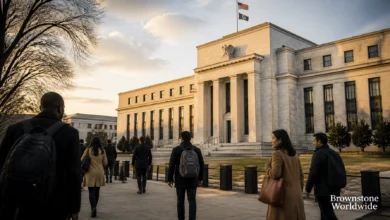
Oil prices sink, stocks soar after Trump announces deal with Iran

Oil prices experienced a significant drop following President Trump’s announcement of a deal with Iran to reopen the vital Strait of Hormuz, responsible for approximately 20% of global crude oil transportation. This development sparked optimism in the stock market, with U.S. stocks surging as businesses and consumers anticipated relief from soaring inflation levels, which reached a three-year high in May.
Brent crude, the international benchmark, plummeted by 4.8% to $83.11, while West Texas Intermediate, the U.S. standard, saw a 5.2% decrease to $80.47. The positive news led to a 1.5% increase in the S&P 500, a 1% gain in the Dow Jones Industrial Average, and a 2.2% surge in the Nasdaq composite index during early trading.
President Trump stated that the Strait of Hormuz would reopen once the deal is finalized, with the U.S. naval blockade on Iran set to be lifted. However, experts caution that it may take several weeks for oil tanker traffic through the strait to reach even half of its pre-war levels. Analysts from Eurasia Group emphasized that shipping and insurance companies would need assurance of the agreement’s stability before resuming oil and gas flows from the region.
While gas prices are expected to ease in the near future, they are unlikely to return to pre-war levels quickly, posing continued financial strain on U.S. households and businesses. Capital Economics chief economist Neil Shearing advised investors that despite the reopening of the strait, inflation may rise further in the short term, leading to economic challenges in the third quarter.
One key concern surrounding the truce is whether Iran will impose toll charges on ships passing through the strait, opposed to the U.S.’ demand for toll-free access. The recent spike in the Consumer Price Index, driven by a surge in energy prices, has further exacerbated the economic impact of the war. Even though fuel prices have slightly decreased in June, Americans are still paying 37% more for gasoline compared to pre-war levels, with the national average price at $4.07 per gallon.
In conclusion, the deal between the U.S. and Iran to reopen the Strait of Hormuz has brought some respite to the oil market and stock prices. However, uncertainties remain regarding the agreement’s implementation, potential toll charges, and the long-term effects on inflation and consumer spending. The journey towards economic recovery post-war is expected to be gradual and challenging for both the U.S. and global markets.