
Election Day 2026: What’s at Stake, What We’re Watching, and Why Every Vote Matters
WASHINGTON, D.C. | Tuesday, November 3, 2026 — It’s Election Day across the United States. Millions of Americans are voting for members of Congress, state officials and local leaders. The midterm elections come amid disagreements over government spending, household costs, healthcare, immigration, international conflict and the balance of power in Washington.
President Donald Trump is not on the ballot this year, but the outcome will shape the laws Congress can pass, federal oversight and the president’s working relationship with lawmakers over the next two years.
What’s at stake in Congress?
U.S. House of Representatives: All 435 voting seats are up for election. The House helps write laws, approve federal spending and investigate government agencies. Which party controls it will help determine which proposals can advance and which oversight issues receive attention.
U.S. Senate: Senate contests will help determine which party controls the chamber responsible for considering federal judges, executive appointments, legislation and treaties. Majorities can shape what makes it to a vote, but passing laws often requires cooperation across both chambers and the president.
What we’re watching on Election Night
Georgia
Georgia voters are choosing statewide officials, including a governor and U.S. senator, as well as congressional and other state and local representatives. We will watch turnout across urban, suburban and rural communities, along with how election officials report and certify results.
Michigan
The U.S. Senate contest between Democrat Abdul El-Sayed and Republican Mike Rogers has drawn attention after Democratic Rep. Haley Stevens endorsed Rogers. El-Sayed’s campaign reported approximately $2.4 million in one day of fundraising following the announcement. Endorsements and reported donations cannot establish how voters will cast ballots.
Alaska
Republican Sen. Dan Sullivan faces Democrat Mary Peltola. A federal judge dismissed a Justice Department lawsuit aimed at delaying election certification under certain circumstances related to another candidate with the same name as Sullivan. The ruling does not decide the election outcome. Alaska’s counting and any further court proceedings will deserve close attention.
Other congressional contests
North Carolina, Maine, Texas, Ohio and additional states have consequential Senate and House contests. Each race contributes to the balance of power in Washington; early results should not be treated as final tallies.
Issues voters say affect everyday life
Household costs: Food prices, housing, utilities, transportation, tariffs and taxes are major concerns. Congress and the executive branch have different roles in economic policy.
Healthcare and workplace rights: Insurance costs, reproductive healthcare and workplace protections are prominent topics. Federal and state law—and court decisions—can shape the rules.
Immigration: Voters face debates over border security, work authorization, immigration enforcement and the powers of federal agencies.
Education and community resources: Decisions on state and federal budgets affect schools, financial aid, transportation and local programs.
Foreign policy: The conflicts involving Iran and Ukraine have raised questions about diplomacy, defense spending, security and energy prices.
Local elections matter, too
Governors, state legislators, county officials and other officeholders influence schools, public safety, roads, housing and local services. Ballots may also contain judicial races or local measures. Checking the whole ballot helps voters understand which decisions are being made in their communities.
What happens after polls close?
Election officials count ballots according to state law. Some states report results quickly; others need time to process absentee, mail and provisional ballots. A close result or late count does not automatically indicate wrongdoing. News organizations may project winners before election authorities complete certification, but projections are not official results.
Georgia: Election Day voting information
Georgia polling places are scheduled to be open 7 a.m. to 7 p.m. local time on November 3. Voters who are in line by 7 p.m. are generally entitled to vote. Go to your assigned Election Day polling location, bring acceptable photo identification and ask poll workers about available options if an eligibility problem arises. Confirm your registration status, location and sample ballot using the state’s official My Voter Page.
Voting rules vary by state, so people outside Georgia should check their state or local election office for accurate instructions.
The Brownstone Bottom Line
Election Day is about representation: who makes laws, approves public spending, oversees the government and makes decisions affecting communities. People can disagree about candidates and policies while still supporting accurate information and lawful voting procedures.
If you are eligible and have not voted, check your polling place and make a plan to participate. Brownstone Worldwide will follow verified results, emerging developments and what the next Congress may mean for the Neighborhood.
Know. Grow. Belong. — Brownstone Worldwide
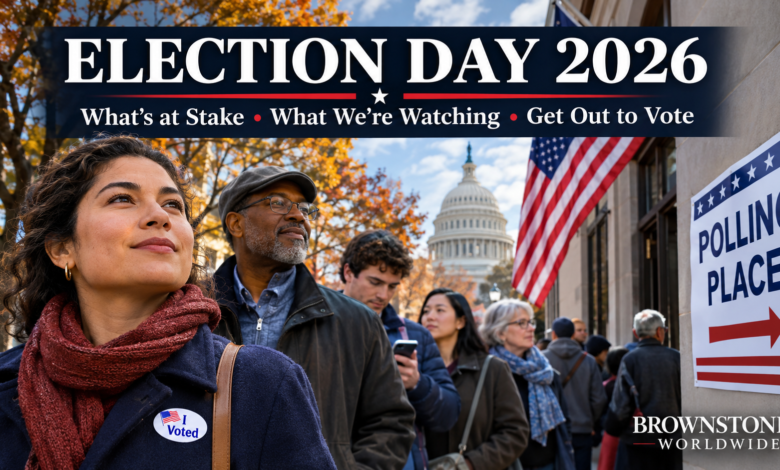
Featured image is an original AI-generated Brownstone Worldwide editorial illustration, not a documentary photograph of voters.