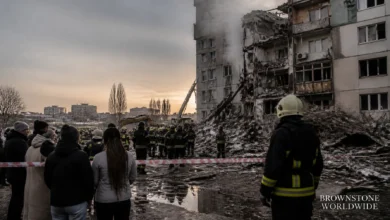
Chemical tank in Southern California no longer under threat of catastrophic explosion, officials say

The operation involved spraying water on the tank and using specialized equipment to lower the temperature inside. Firefighters and hazardous materials teams were on site around the clock to monitor the situation and ensure the safety of the surrounding community.
After several tense days, officials announced that the efforts had been successful in reducing the risk of a catastrophic explosion. The cooling process had been effective in stabilizing the tank and preventing any further escalation of the situation.
Residents who had been evacuated were relieved to hear the news that the threat had been mitigated. Many had been staying with friends or in emergency shelters, unsure of when they would be able to return home.
While the immediate danger has passed, authorities continue to monitor the situation closely. The evacuation orders remain in place as a precautionary measure until the area is deemed safe for residents to return.
The incident serves as a reminder of the potential risks associated with industrial facilities handling hazardous materials. It highlights the importance of preparedness and swift response in dealing with emergencies to protect public safety.
Officials are conducting a thorough investigation into the root cause of the chemical tank’s malfunction to prevent similar incidents in the future. They are also assessing the environmental impact of the incident and working to ensure the proper cleanup and disposal of any contaminated materials.
In the meantime, residents are urged to continue following evacuation orders and stay informed about developments in the situation. The swift action taken by emergency responders and government agencies has helped avert a potential disaster, but the need for vigilance and caution remains paramount.
Firefighters discovered a crack in a tank late Saturday, which helped to release some of the pressure within the tank, according to Covey. While officials were confident that the crack wouldn’t result in any chemical leaks, they continued to monitor air quality in the region to ensure safety.
An evacuation zone of roughly 10 square miles was established, encompassing schools, hospitals, nursing homes, fire and law enforcement stations, and critical infrastructure. Multiple roads in the area were also closed for safety measures.
Despite the evacuation zone, areas outside of it were deemed completely safe for day-to-day activities to continue as normal, as stated in an update by the OCFA on Sunday afternoon. Families were seen setting up tents after evacuating from their homes due to the chemical leak threat.
GKN, the company responsible for the storage tank incident, worked with technical specialists to assess the tank more closely and safely remove external insulation material to cool its contents. However, the Orange County District Attorney, Todd Spitzer, launched a criminal probe into the incident, ordering the company not to destroy or manipulate any records.
Spitzer’s investigation aims to determine how such a toxic failure could have occurred at a major military and commercial aircraft gear manufacturer like GKN Aerospace. He established an anonymous tip line and online reporting form for anyone with information, including current and former employees of the company, to come forward.
In response to the investigation, GKN declined to comment specifically but expressed gratitude for the efforts of the OCFA, EPA, and other agencies in mitigating the risk of a leak. The company apologized for the disruption caused by the incident and emphasized their priority of resolving it safely for residents to return home promptly.
The situation remains volatile, with Spitzer emphasizing the importance of thorough investigation to prevent potential disasters and ensure the safety of human life. The company’s cooperation with authorities and dedication to resolving the incident were highlighted in their statement.
ABC News’ team contributed to this report, providing updates on the ongoing investigation and efforts to address the tank incident. The world of technology is constantly evolving, with new advancements and innovations being made every day. One of the most exciting developments in recent years is the rise of artificial intelligence (AI) and machine learning.
AI refers to the simulation of human intelligence in machines that are programmed to think and learn like humans. Machine learning is a subset of AI that enables machines to learn from data without being explicitly programmed. Together, these technologies have the potential to revolutionize industries and improve the way we live and work.
One area where AI and machine learning are making a significant impact is in healthcare. These technologies are being used to analyze medical data, diagnose diseases, and even develop new treatments. For example, AI algorithms can analyze medical images such as X-rays and MRIs to detect abnormalities that may be missed by human radiologists. This can lead to earlier and more accurate diagnoses, ultimately saving lives.
In addition to diagnostics, AI is also being used to personalize treatment plans for patients. By analyzing large amounts of medical data, AI algorithms can predict how different patients will respond to various treatments and medications. This can help doctors tailor treatment plans to individual patients, improving outcomes and reducing side effects.
AI and machine learning are also being used to streamline administrative tasks in healthcare. For example, chatbots powered by AI can assist patients with scheduling appointments, answering questions, and even providing basic medical advice. This can free up healthcare providers to focus on more complex tasks and improve the overall patient experience.
Outside of healthcare, AI and machine learning are being used in a wide range of industries, from finance to retail to transportation. In finance, AI algorithms are being used to detect fraud, predict market trends, and automate trading. In retail, AI is being used to personalize shopping experiences, optimize inventory management, and improve customer service. In transportation, AI is being used to develop self-driving cars, optimize traffic flow, and improve public transportation systems.
As AI and machine learning continue to advance, it is important to consider the ethical implications of these technologies. There are concerns about data privacy, algorithm bias, and the potential for job displacement as more tasks are automated. It will be crucial for policymakers, industry leaders, and technologists to work together to ensure that AI is developed and deployed responsibly.
Overall, the rise of artificial intelligence and machine learning holds great promise for improving our lives and driving innovation across industries. By harnessing the power of these technologies, we can create a brighter future for all.