

NASA Highlights Mars’ Extraordinary 1,500-Kilometer Water-Ice Cloud
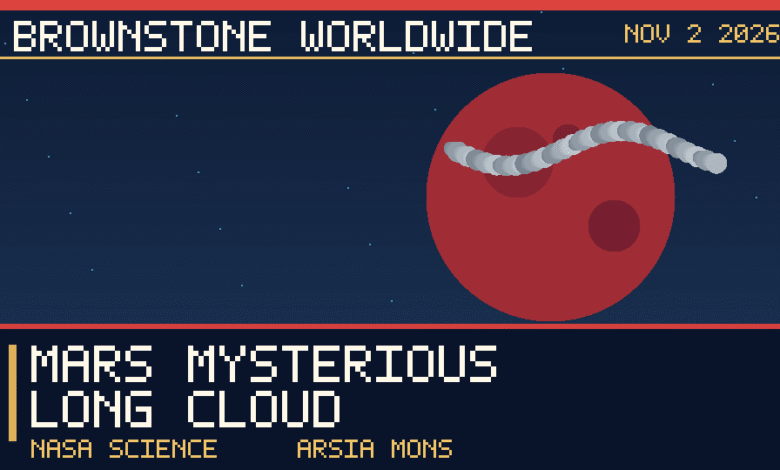
BROWNSTONE WORLDWIDE | SCIENCE | November 2, 2026 — Mars is known for its dusty, rust-colored landscapes, but the planet also produces clouds. NASA’s Astronomy Picture of the Day for Monday, November 2, spotlights an especially striking example: a narrow white cloud that can extend more than 1,500 kilometers from the Arsia Mons volcano.
A cloud that behaves unlike Earth’s familiar clouds
The feature is called the Arsia Mons Elongated Cloud, or AMEC. According to NASA, it was first recorded by Viking Orbiter 2 in 1977 and later studied in greater detail by the European Space Agency’s Mars Express spacecraft. The image highlighted in the November 2 feature was captured in 2018; NASA’s publication is a fresh explanation of a known phenomenon, not an announcement that the cloud was discovered this week.
The cloud is composed of water ice, not smoke from an active eruption. It forms near Arsia Mons during particular Martian spring and summer mornings, then stretches downwind as the atmosphere carries the icy material away from the volcano.
Why scientists are still interested
Clouds form on Earth when water condenses or freezes around tiny airborne particles. NASA notes that the thin upper Martian atmosphere and apparent lack of sufficient dust complicate the usual explanation for this cloud’s formation. Researchers continue to investigate the process and the influence of local winds and terrain.
Its regular seasonal timing is especially useful: scientists can compare observations across years to test how Martian atmospheric conditions change. Understanding water-ice clouds also contributes to the broader study of how water moves through Mars’ climate system.
What it means
The long cloud offers a reminder that Mars has active weather even without Earth’s dense atmosphere. For readers following planetary exploration, it is a vivid example of how archived spacecraft images continue to raise scientific questions long after they are taken.
Source: NASA Science, Astronomy Picture of the Day, November 2, 2026. Featured graphic is an original editorial illustration, not the NASA/ESA spacecraft image.