

Why the Moon Can Look Red, Yellow or Blue: NASA Highlights a Decade of Lunar Colors
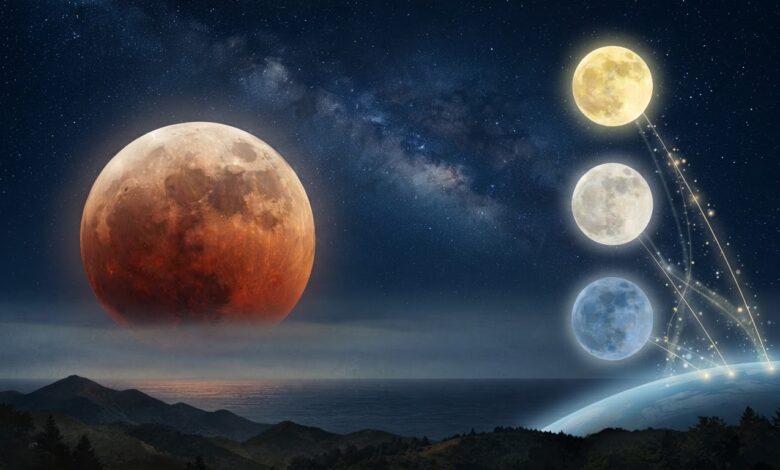
November 1, 2026 | Science — The Moon is often described as silver or white, but observers sometimes see it glow gold, orange, red and even blue. NASA’s Astronomy Picture of the Day for November 1 uses a collection of photographs taken over ten years by astrophotographer Marcella Giulia Pace in Italy to explain why the same lunar surface can appear so different from Earth.
The Moon does not change paint colors
The Moon reflects sunlight. Viewed outside Earth’s atmosphere, its surface generally appears gray with a brownish tint. But for people on the ground, that reflected light must travel through the atmosphere before reaching the eye or camera. The distance it travels, along with particles in the air, changes the colors that are most visible.
A Moon close to the horizon can appear yellow, orange or red because its light passes through more of the atmosphere. Shorter blue wavelengths are scattered away more effectively along the longer path, leaving warmer colors more prominent. Dust or haze can strengthen the effect.
What makes a blue Moon actually look blue?
The familiar phrase “blue moon” usually refers to a calendar or seasonal definition and does not mean the Moon literally turns blue. A genuinely blue-looking Moon is uncommon. NASA notes that larger particles in the atmosphere can sometimes contribute to the effect. The exact mix of particles and lighting conditions matters.
The November 1 presentation also includes a purple-looking Moon, but NASA says the cause of that particular appearance is uncertain. It would be misleading to present every unusual color as having one simple explanation.
Why a lunar eclipse looks red
During a total lunar eclipse, Earth moves between the Sun and Moon. Some sunlight bends through Earth’s atmosphere and reaches the Moon after much of the blue light has been scattered out, producing a coppery or reddish appearance. NASA’s selection includes a view from the July 2018 total lunar eclipse.
How to see the difference yourself
On a clear night, compare the Moon when it is low on the horizon with how it looks higher in the sky. The change may be subtle, and clouds, pollution, smoke and camera settings can influence the result. A phone photograph may not perfectly match what your eyes see.
What it means for the Neighborhood
This is a reminder that astronomy can be observed without specialized equipment. A change in the Moon’s apparent color is usually an atmospheric effect, not evidence that the Moon itself has changed. NASA’s daily astronomy feature provides a reliable starting point for learning more.
Source: NASA Astronomy Picture of the Day — Colors of the Moon, November 1, 2026; NASA APOD archive and current feature. Featured image: original Brownstone Worldwide illustration, not the copyrighted astrophotograph discussed in NASA’s feature.