

USS George Washington Leaves Middle East, Reducing U.S. Carrier Presence Near Iran to Two
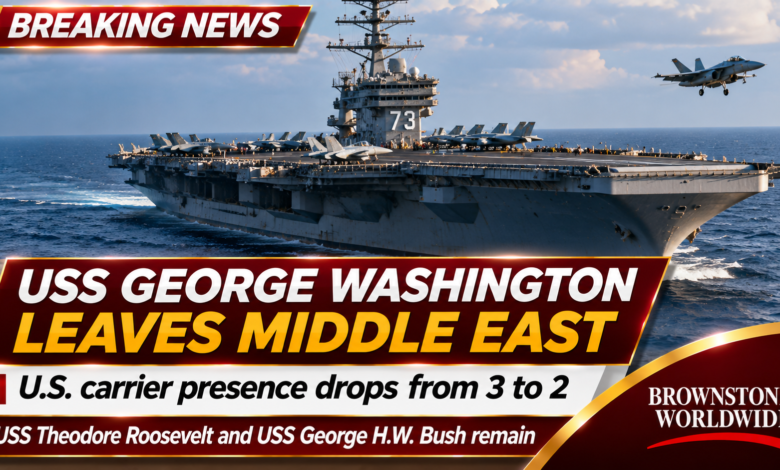
WASHINGTON — November 18, 2026. The USS George Washington has departed the Middle East, bringing the number of American aircraft carriers supporting operations involving Iran back down to two after a brief three-carrier overlap, the Associated Press and USNI News reported Wednesday.
A U.S. Pacific Fleet spokesperson, Cmdr. Katie Koenig, confirmed that the Japan-based George Washington was back under Pacific Fleet control and conducting routine operations in the Asia-Pacific. The ship had been operating in the Middle East since August.
Which American carriers remain near Iran?
The USS Theodore Roosevelt, which arrived in the region Sunday, November 15, and the USS George H.W. Bush, which has been operating there since April, are now the two aircraft carriers supporting U.S. operations in the Middle East. They operate alongside more than a dozen other U.S. warships, including destroyers, cruisers and a littoral combat ship, according to AP.
The Roosevelt‘s arrival briefly increased the carrier count to three before the George Washington departed. USNI News describes the sequence as a planned relief of carrier forces rather than a complete pullback from the region.
Does this mean the Iran war is ending?
No such conclusion is supported by the carrier movement alone. The United States continues to maintain a substantial naval presence and a blockade affecting shipping to and from Iran. The blockade is intended to increase economic pressure on Tehran. U.S. forces have also conducted limited strikes on Iranian targets near the Strait of Hormuz, according to AP.
President Donald Trump has sent mixed signals about the possibility of further major strikes. He has described the military phase as effectively over while also warning that U.S. forces remain prepared to act if necessary. No final negotiated settlement has been announced.
Why the Strait of Hormuz matters
The Strait of Hormuz is a critical maritime passage for global energy trade. Disruptions to commercial shipping there have contributed to higher energy prices, raising concerns about fuel costs and broader inflation. The movement of an aircraft carrier does not itself determine whether the blockade or those disruptions will end.
What happens to the USS George Washington?
USNI News reported that the carrier had returned to U.S. Seventh Fleet operations. The Pacific Fleet spokesperson did not specify the ship’s full onward itinerary or which escort vessels accompanied it. Because military deployments can change, a return to Pacific Fleet control should not be described as confirmation that the ship is heading directly to its home port in Japan.
The bigger picture
Maintaining multiple carrier strike groups near Iran requires substantial numbers of sailors, aircraft, escort ships and logistics resources. Extended deployments have also raised concerns among sailors’ families about operational strain. The latest rotation leaves two carriers in the Middle East while allowing the George Washington to resume operations under the Pacific Fleet.
Bottom line: The three-carrier deployment was temporary. The George Washington has departed; the Theodore Roosevelt and George H.W. Bush remain. The U.S. military posture toward Iran remains significant despite the reduced carrier count.
Sources: Associated Press, November 18, 2026; USNI News, November 18, 2026; USNI News, November 16, 2026.
Featured image is a Brownstone Worldwide editorial illustration, not a documentary photograph of this week’s carrier movement.